Native American leaders seek more from US consultations
Apr 2, 2022
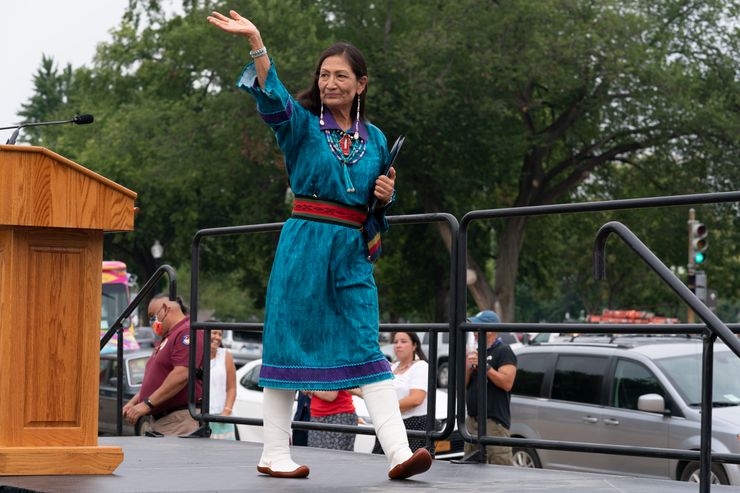
U.S. Interior Secretary Deb Haaland vowed on her first day on the job to ensure Native American tribes have opportunities to speak with her and the agencies she oversees
ALBUQUERQUE, N.M. (AP) — It was a quick trip for U.S. Interior Secretary Deb Haaland with stops to hike through desert scrub near the U.S.-Mexico border and to marvel at the jagged Organ Mountains before soaking in what life was like in one of the oldest settlements along a historic trade route.
For Haaland, the time spent in West Texas and New Mexico over recent days helped to highlight the work being done to conserve parts of the borderlands.
But it also marked an opportunity for Haaland — as head of the agency that has broad oversight of tribal affairs — to deliver on promises to meet with Native American tribes that have grown increasingly frustrated about the federal government’s failure to include them when making decisions about land management, energy development or the protection of sacred sites.
Haaland’s selection as the first Native American to serve in the position opened a door for tribes who pointed to a history fraught with broken promises.
“I want the era where tribes have been on the back burner to be over, and I want to make sure that they have real opportunities to have a seat at the table,” Haaland said on March 17, 2021, her first day on the job.
Haaland has since met with nearly 130 of the nation’s 574 federally recognized tribes as she seeks to overhaul a federal system that has limited Native American relations to a check-the-box exercise.
And while some tribes say her aspirations are admirable, others remain skeptical they will see real change and say they have yet to experience meaningful dialogue with the federal government or key decision makers.
Haaland's department has developed a plan for improving formal consultations with tribes and established an advisory committee that will aid with communication once it's up and running. In an effort to make consultation a hallmark of her tenure, Haaland has said she wants integration of tribal input to become second nature for her employees.
There has been some success as tribes felt heard when the Biden administration restored the original boundaries of Bears Ears National Monument in Utah and when the U.S. Department of Agriculture pulled back an environmental impact statement that paved the way for an Arizona copper mining operation to consult further with tribes.
But frustrations persist among tribal leaders who say their conversations with the federal government have not resulted in action on the ground.
For the Ute Indian Tribe in Utah, those frustrations lie in management of the Colorado River basin as western states grapple with less water amid a megadrought and climate change. Tribes were not included in a century-old compact that divvied up the water, and the Ute tribe says it's seeing the same exclusion now.
The tribe's Business Committee has spent hours in meetings and preparing formal comments and says it's tired of having to reiterate its position that the federal government must protect the tribe's water rights or support development of water infrastructure to serve the reservation.
Committee Chairman Shaun Chapoose said he's seen proposals, but “actual where-the-rubber-meets-the-road stuff hasn't occurred yet, and the drought gets worse.”
There are similar sentiments among Navajo Nation lawmakers who are concerned about Haaland’s plans to make oil and gas development off-limits on federal land surrounding Chaco Culture National Historical Park in northwestern New Mexico.
Advocacy groups sent a letter to Haaland on Thursday, saying more needs to be done to include tribes as her department charts a path forward for protecting culturally significant areas in northwestern New Mexico.
The Interior Department said more meetings with the Navajo Nation and other tribes are planned in April and that Navajo-language translators will be present.
In Nevada, several tribes and the National Congress of American Indians have asked the Interior Department and the U.S. Bureau of Land Management to uphold a duty to engage in “robust and adequate” tribal consultation regarding plans for a massive lithium mine at Thacker Pass. So far, the tribes say that hasn’t happened.
Under the U.S. Constitution, treaties and statutes, the federal government must consult meaningfully and in good faith with Native American and Alaska Natives tribes when making decisions or taking action that is expected to impact them.
However, a 2019 report from a government watchdog found some federal agencies lacked respect for tribal sovereignty, didn't have enough resources for consultation or couldn't always reach tribes.
Another top complaint from tribes is that they are brought in when a course of action already has been set, instead of including them in the earliest phases of planning.
“The federal government says all the right words, but their mentality is one in which they are not really doing this in a way that reflects the proper government-to-government relationship that I think tribes are orienting to when they enter into these conversations,” said Justin Richland, a professor at the University of California-Irvine School of Social Sciences who specializes in Native American law and politics.
Consultation doesn't always lead to action or create any substantive rights on the part of the tribes, making it somewhat of a “toothless tiger,” said Dylan Hedden-Nicely, a citizen of the Cherokee Nation who directs the Native American Law Program at the University of Idaho.
He said it's reasonable, although incorrect, to think things would move quickly with Haaland — a member of Laguna Pueblo in New Mexico — because she had a base of knowledge about Indian Country when she took the office. But the groundwork is still being laid to effectuate real change, Hedden-Nicely said.
"It’s not immediate, but it’s going to be worth the wait, I'm hoping," he said.
During Haaland's confirmation hearings, Interior staff consulted with tribes on how to improve the process.
“Secretary Haaland and the entire department take our commitment to strengthening tribal sovereignty and self-governance seriously, and we have affirmed that robust consultations are the cornerstones of federal Indian policy,” department spokesman Tyler Cherry said in a statement to The Associated Press.
President Joe Biden issued a memo during his first month in office, reaffirming previous executive orders on tribal consultation and directing federal agencies to spell out how they'll comply. That set in motion Haaland's efforts to give tribal leaders a direct line of communication to the Interior Department.
A congressional committee is scheduled next week to consider a bill by Democratic U.S. Rep. Raúl Grijalva of Arizona that would codify a framework for tribal consultation that supporters say would insulate the process from changes in administration.
The legislation faces an uphill battle, and some tribes want to ensure that it includes a pathway not only for the federal government to initiate consultation, but for tribal leaders to start conversations, too. Similar legislation introduced in the past has failed.
For Amber Torres, chair of the Walker River Paiute Tribe in Nevada, consultation should be more than a generic letter or email.
“I want true, meaningful, face-to-face dialogue with a timeline, intent and follow-up and next steps agreed by both parties,” she said. "Making the tribal consultation process a law is long overdue, and it would be a step in the right direction to ensure tribal nation sovereignty is protected.”
___
Fonseca reported from Flagstaff, Arizona.