What Happens Between Your BOM and Your Finished Product

Sep 29, 2026



Shenzhen, Guangdong Sep 28, 2026 (Issuewire.com) - Last Friday, September 11th, a hardware team from a South Korean device manufacturer flew into Shenzhen for something most suppliers dread: an audit with no slides allowed. They didn't want a PowerPoint. They wanted to walk the floor, watch the line run, and see exactly what happens to their boards between "order confirmed" and "box shipped."

That visit is the reason we're writing this. Most buyers only ever see two data points from a PCBA supplier: a quote and a certificate wall. What actually determines whether a board works in the field -- and keeps working after six months inside a customer's product -- happens in between, on the floor, in steps most quotes never mention. Here's what we walked them through.

Before a single component is placed

Every job starts with a DFM (Design for Manufacturability) review, not a purchase order stamp. Our engineering team checks footprint tolerances, panelization, pad spacing, and component placement against what our SMT lines can actually run. This is the cheapest place to catch a problem. A footprint issue found here costs an email. The same issue found after the first production run costs a batch of scrap, a delayed shipment, and a hard conversation with your own customers. We'd rather have that conversation with you two days into a project than two weeks before your ship date.

Where the components actually come from

Sourcing is where a lot of quality problems quietly start at other suppliers -- cheaper gray-market parts swapped in without telling the customer. We source through Mouser, Digi-Key, Farnell, Future, Avnet, and Arrow, alongside direct manufacturer and authorized agent relationships. No substitutions go out without customer sign-off, full stop. If a part is genuinely unavailable and a customer agrees to an alternative, our engineering team evaluates the swap for cost and performance before it's approved -- not after it's already on the board. Every incoming batch, regardless of source, goes through IQC (Incoming Quality Control) before it's cleared for the line, checking for counterfeit risk, dimensional accuracy, and datasheet compliance.

Inside the build: SMT and DIP

STHL runs 7 high-speed SMT production lines and 2 DIP/THT assembly lines across a 10,000 sqm facility staffed by more than 200 people. On the SMT side, each line pairs automated solder paste printing with SPI (Solder Paste Inspection), which checks paste volume and alignment before a board ever reaches the reflow oven -- because most solder defects trace back to paste problems, not placement problems. After reflow, AOI (Automated Optical Inspection) checks every board for placement accuracy, tombstoning, and bridging before it moves further down the line.

For through-hole components -- connectors, heat sinks, DC fans, and mechanical hardware that SMT can't handle -- our 2 DIP/THT lines run wave soldering up to 300°C, with fixtures used to protect sensitive components during the process. Our ERP and MES systems track every board through this entire sequence by batch, which is how we can quote a 99% first-pass yield and actually pull up the number for any given production run instead of just citing it as a marketing line.

Proving it works, not just that it looks right

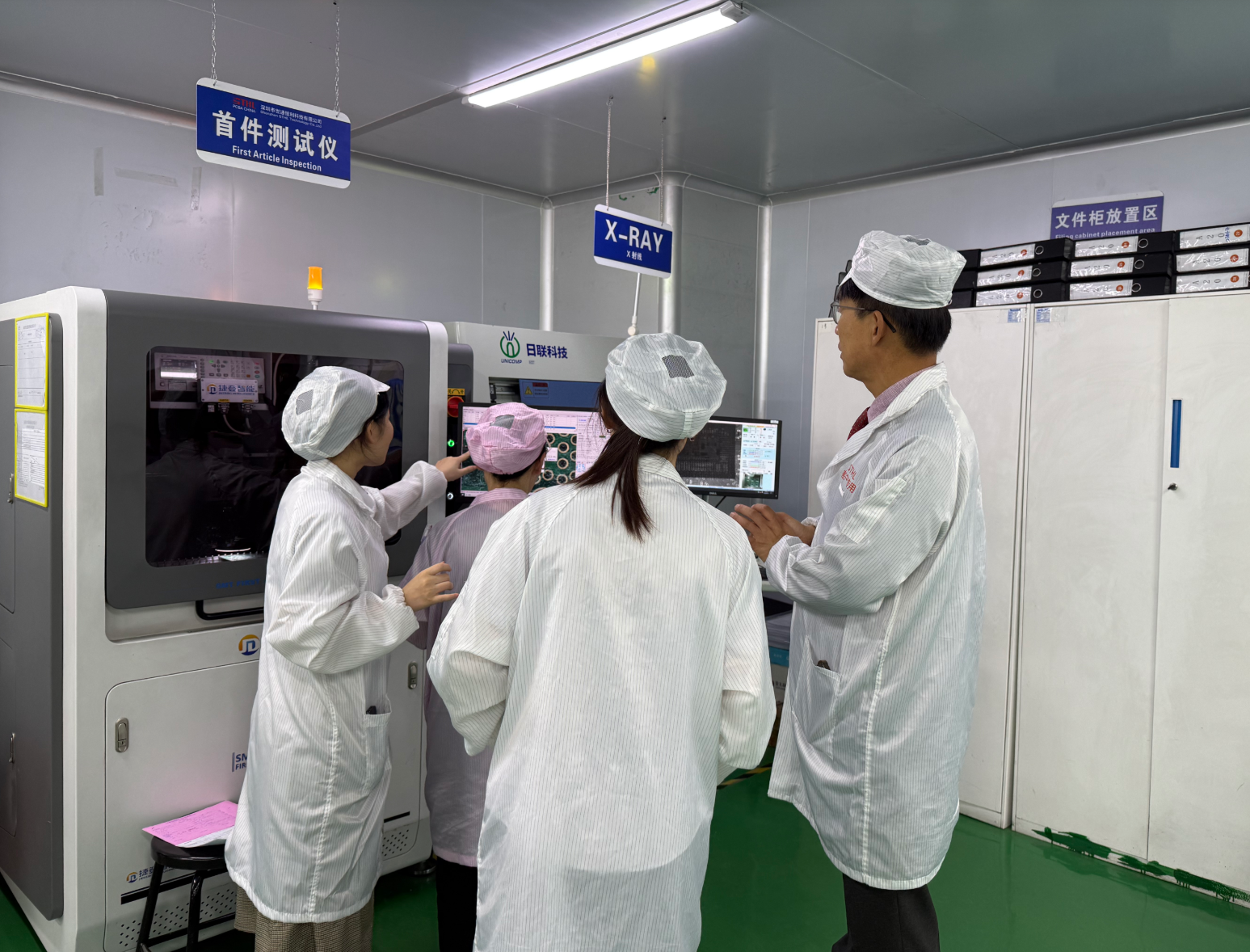
This is usually the part clients find most reassuring, because it's the part that catches what a visual inspection alone would miss. Beyond AOI, boards go through X-ray inspection to check hidden solder joints under BGA and QFN packages -- connections you'd otherwise never see until the board fails in the field. From there, boards move to ICT (In-Circuit Test) using flying-probe testing, followed by full functional testing on our dual FCT (Functional Circuit Test) lines. Final inspection includes OQC (Outgoing Quality Control) and 3D microscope verification before anything gets cleared for packing.

For customers running box-build or finished-device programs, we also operate 2 dedicated box-build assembly lines for labeling, Housing Assembly, and final packing -- so the board that leaves QC isn't the last step before it reaches your warehouse.

Why a certificate wall isn't the whole story

We do hold IATF16949 (automotive), ISO9001 (quality management), ISO13485 (medical devices), and ISO14001 (environmental) -- and they matter, because they force a documented, auditable process across the whole factory rather than a one-off effort for a big customer. But a certification describes a system that's supposed to be in place. A site visit is where a client actually checks whether it is. Our Korean visitors didn't ask to see the certificates on the wall -- they asked to see the SPI reject rate on the line running that day, and to watch a board go through ICT in real time.

What we'd suggest asking on your own visit

If you're evaluating a PCBA partner and a spec sheet isn't giving you enough to decide, here's what tends to actually reveal how a factory runs day to day: ask to see the DFM report for a recent project, not just the final board. Ask what happens to a batch that fails AOI -- is there a documented rework process, or does it just get quietly reworked off the books? Ask to see MES data for a specific batch number, not a summary dashboard. And ask where your production schedule sits relative to other jobs on the line right now -- a supplier that can answer that in real time is one that actually knows what's happening on their own floor.

Our Korean visitors left with photos of the SMT line mid-run, a copy of their DFM review notes, and a production schedule showing exactly where their first batch sits in the queue. Not a brochure.

If your team is weighing a PCBA partner and would rather see the floor than read another deck, we host client visits and virtual factory walkthroughs regularly -- reach out and we'll set one up.
Media Contact

Shenzhen STHL Electronics Co., Ltd.


*****@sthlpcba.com

https://www.sthlpcba.com/

Source :Shenzhen STHL Electronics Co., Ltd.

This article was originally published by IssueWire. Read the original article here.

More News

‘Red Crown’ challenges beauty queen stereotypes through satire, suspense 

Oct 13, 2026

‘Red Crown’ challenges beauty queen stereotypes through satire, suspense 

Beauty queens are often expected to appear flawless, deliver polished answers and maintain a perfect image, but GMA Pictures’ upcoming film “Red Crown” aims to reveal the imperfections, personal struggles and humanity behind the glamour of pageantry.  Featuring real-life beauty queens, actresses and digital personalities, the satirical thriller explores a fictional competition in which 25 women vie for a P25 million prize, with the stakes extending beyond the usual fight for a crown.  During the film’s recent media conference, the cast discussed how the project challenges stereotypes about beauty queens, examines the pressures of competition, and highlights the importance of authenticity and sisterhood.  Miss Universe Philippines 2013 Ara Arida, who is among the real-life beauty queens in the ensemble, said the film seeks to remind audiences that women in pageantry experience the same emotions and make mistakes like everyone else.  “Beauty queens are humans as well. We’ve been stereotyped that this is how we look, this is how we act but in reality, we can feel sad and be funny as well. We make mistakes but what’s important is we know how to handle it, and we know how to stand up after every mistake,” Arida said.   Miss Chinatown Philippines 2025 Yza Thalia Uy, who plays beauty influencer Faith Villacorta, said her character also challenges the expectation that women must always present a carefully curated image of themselves.   As an influencer, her character is associated with finding the perfect angle, lighting, opportunity, content and appearance. Uy said the film questions the pressure to meet those standards.  “For me, being a true queen or a true woman is all about how you genuinely connect with the people around you. And the first person you’d like to connect with is yourself,” Uy said.  Her sister, Supermodel Universe 2025 International Grand titleholder Yna Angela Uy, also emphasized that pageantry should be about more than physical appearance and confidence.  “It’s not just about the beauty or its facade, but what’s more important is our heart, our truest self,” she said.  Beyond the fight for the crown  Miss Universe Philippines 2023 Michelle Marquez Dee described “Red Crown” as an exaggerated take on the world of beauty pageants, using satire to magnify the pressures and power dynamics that can exist behind the scenes.  “Red Crown is when you take a beauty pageant to the extreme,” Dee said.  She pointed to a scene involving a puppet as an example of how pageant directors can influence contestants behind the scenes.  “Usually in the pageants that we love, we’re fighting for one crown. But this time, we’re fighting for our lives,” Dee said.  She also recalled a conversation with co-star Miss Universe Philippines 2025 Ahtisa Manalo, who described the characters as satirical exaggerations of themselves.  The film’s premise pushes the familiar rivalry among contestants into more dangerous territory, combining the spectacle of pageantry with suspense and comedy.  Director Dominic Zapata said bringing together a large ensemble of performers from different backgrounds was a significant undertaking, but the story offered an opportunity to deliver a broader social message.  “It’s kind of a social statement. This film uses the suspense-thriller genre,” Zapata said.  Ruffa Gutierrez, who plays the national director of the fictional pageant, said the film brings together two industries that have shaped her career.  “The showbiz industry taught me how to tell a story, and pageantry taught me how to own the stage,” she said.  Gutierrez described the film as campy and exciting, with elements of horror and suspense. She also expressed hope that her first collaboration with GMA Pictures would lead to more projects.  Competition, sisterhood  While “Red Crown” dramatizes the rivalry among contestants, its cast members also used the media conference to discuss what healthy competition should look like in an industry where women are frequently compared with one another.   Sanya Lopez said competitiveness does not have to come at the expense of kindness and respect.   “You can still win, you still want to win, but there should be goodness in your heart. Just be nice, be respectful, and it’s a healthy competition when you inspire other women,” Lopez said.  She encouraged women to help one another gain confidence rather than treating fellow contestants solely as rivals.  Faith Da Silva echoed the sentiment, emphasizing that another person’s achievements should not diminish one’s own accomplishments.  “Healthy competition means you shouldn’t compare yourself with other people. The success of other people doesn’t take away your own,” she said, adding that everyone has different strengths, weaknesses, perso­nalities and backgrounds.  Shuvee Etrata said women should make room for one another to succeed instead of viewing opportunities as limited to a single person.  “You lift each other up, you respect each other, and I believe there’s always room for another woman to shine,” she said.  Ashley Ortega, who competed against other athletes as a figure skater, said strong competitors motivated her to improve rather than undermine those around her.  “In a competition, there should always be growth, respect and sisterhood. If there’s comparison or jealousy, I feel like you have lost the competition already,” Ortega said.  She added that learning to accept defeat was an important part of her own experience, allowing her to move forward instead of abandoning her ambitions.  Directed by Dominic Zapata and written by Kit Villanueva and Ken de Leon, “Red Crown” is scheduled to open in Philippine cinemas on Oct. 28.

How to catch your breath

Oct 13, 2026

How to catch your breath

When life feels too fast, your body and mind are asking for a reset. You don’t need an hour-long retreat. Sometimes, all you need is a moment. You can use these techniques anywhere, even in the middle of a busy day. Box breathing: Inhale through your nose for four seconds. Hold for four seconds, exhale through your mouth for four seconds, then hold your breath for another four seconds. Repeat four times. This helps slow your heart rate and signals to your nervous system that you are safe. Drop and Release: Unclench your jaw, lower your shoulders and open your hands. We often hold stress in our bodies without even realizing it. Water and grounding: Take one slow sip of water. Then name three things you can see, two things you can hear and one thing you can feel. This exercise draws you out of your thoughts and brings you back to the present. Calm the mental noise Brain Dump: Write down everything swirling in your head. Getting it out of your mind and onto paper makes it feel smaller. The “not now” list: You can’t do everything today. Choose three things that truly matter and allow the rest to wait. Step away from screens: Scrolling isn’t rest. Staring out a window, listening to one song or sitting in silence can give your brain the space it needs. Your body often gives you signals before you reach the point of exhaustion. Learn to recognize them instead of pushing through. Listen to your body: Pay attention to headaches, a tight chest, trouble sleeping, sudden fatigue or feeling wired but exhausted. These can be signs that your system is overloaded. Listen to your emotions: Irritability over small things, crying out of nowhere, feeling numb or anxiety that won’t shut off are signals worth noticing. If you’re snapping at people you love, that’s a red flag. Listen to your thinking: You can’t focus. You keep replaying the same worry. Every decision feels impossible. You find yourself catastrophizing or going blank. The effects may also show on your face: a sallow complexion, dark circles under your eyes, that unmistakably sleepy look and brain fog. How to pause well Name it: Say, “I’m overwhelmed and I need a break.” Saying it out loud gives you permission. Take 10 minutes, not 10 days: Go for a short walk, take a bathroom break or sit in your car in silence. Don’t fill it: No phone, no emails. Real pause means space. Breathe, pray, or just sit. Protect it: It’s okay to say “I’ll get back to you after I take 10.” Boundaries are not selfish. They are life-savers. Remember, pausing isn’t quitting. It’s maintenance. You can’t pour from an empty cup, and you can’t lead, love or work well when you’re running on fumes. Rest is an integral part of the work. Affirmation: “I will overcome.” Love and light.

YOUR NEWS, OUR NETWORK.

Do you have Great News you want to tell the world?

Be it updates about your business or your community, you can make sure that it’s heard by submitting your story to our network reaching hundreds of news sites across 6 verticals.