Simular releases Sai, ushers in new era of autonomous computer fleets
Sep 23, 2026
Simular has made Sai, its computer use agent, generally available. Sai can now run computers autonomously for hours, spawn helper agents, and scale work across 100 machines in parallel for less than $1
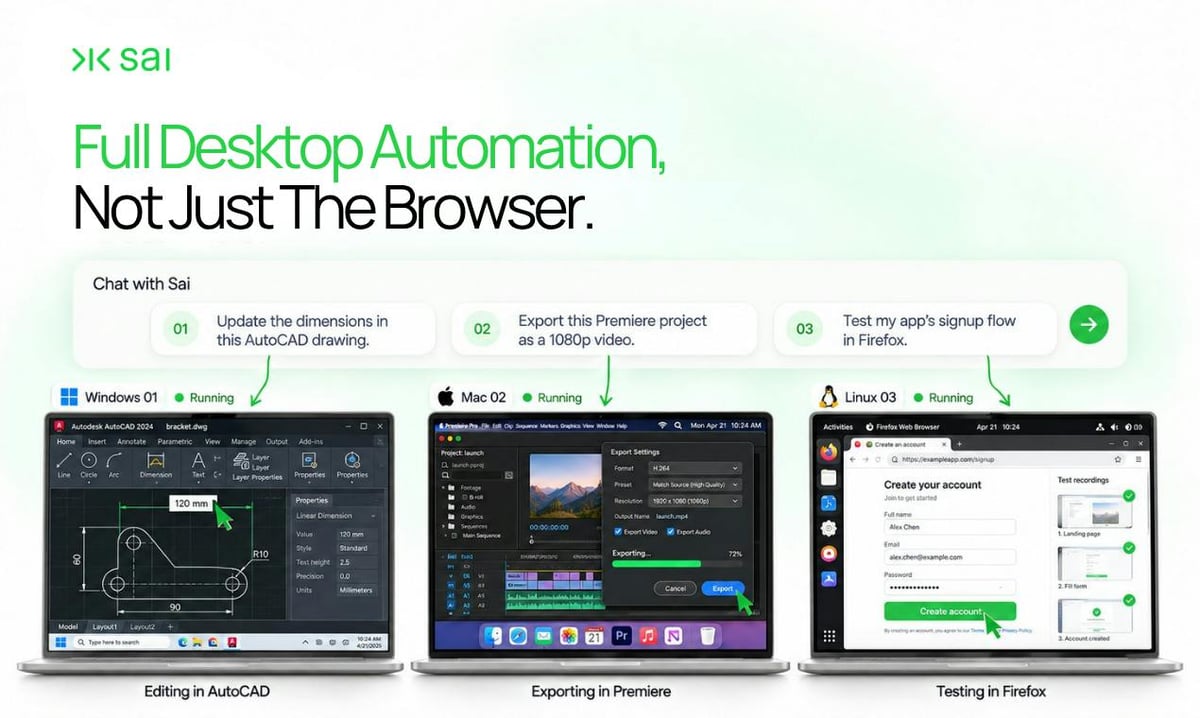
Palo Alto, United States, September 23, 2026 -- Simular, the autonomous computer company, announced the general availability of Sai, its computer-use agent, at sai.work. Sai can spawn a fleet of autonomous computers that execute tasks on multiple machines simultaneously, furthering the company’s mission to free people from laborious, repetitive digital work.
Sai operates computers directly: it reads screens, clicks, types, navigates applications, and plans what to do next. Users can assign work to one or multiple computers, monitor progress remotely, and receive a notification when the work is complete. Sai was invite-only before its general availability.
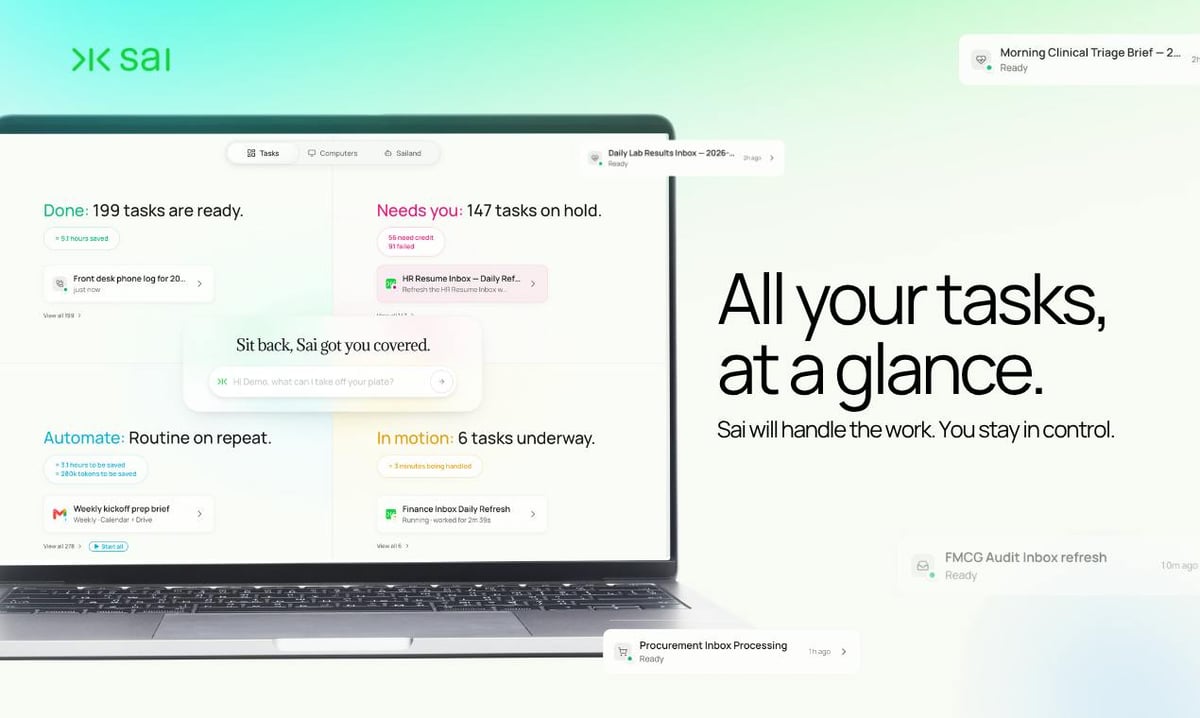
The company introduces #SaiFleet as a new paradigm for computer-use agents: instead of one AI agent operating one computer at a time, users can deploy fleets of autonomous computers to work in parallel.
Because Sai works through the computer interface rather than integrations, it can operate software that has no application programming interface (API), including legacy desktop applications and internal portals behind a login. It runs on Windows, macOS and Linux, either on a cloud-based virtual machine (VM) that Simular provisions or on the user's own device. Users can watch any computer in the fleet while it works and take back control of the mouse during a run. Sai asks for permissions on critical actions, and results arrive through iMessage, SMS or Telegram.
Sai is available now at sai.work, starting free with options for pay-as-you-go, unlimited access, and enterprise-grade scaling and security.
To demonstrate Sai’s ability to handle long, complex computer tasks, the company streams the agent playing Minecraft live. Sai played autonomously for 14 hours, without step-by-step human intervention. It read the game screen, decided what to do next, and spawned helper agents: including Jev, to handle tasks like mining while the main agent continued working on other objectives.
Sai completed eight of fifteen goals in the session, costing approximately $0.01 per hour. That means the #SaiFleet can run 100 computers in parallel for less than $1 in total, opening the possibility of autonomous fleets performing hundreds of tasks simultaneously, from research and data entry to browser workflows, software testing, operations, and other repetitive digital labor.
“We believe the future of computer use is not one agent doing one task, but autonomous computers working together at scale,” said Ang Li, CEO and cofounder of Simular. “Our goal is to make digital labor faster, cheaper, and increasingly accessible so people can spend their time on the things only humans can do.”
Agents often rely on large language models to reason through every step of a task. For repetitive workflows, that can make automation expensive and slow.
Sai takes a different approach. Its neuro-symbolic architecture uses AI models to determine how a task should be completed, then it compiles the resulting procedure into executable scripts. When the same workflow runs again, Sai replays the code rather than reasoning through every step from scratch. If the interface changes, Sai returns to the base model for planning as part of a self-optimization mechanism.
Completed workflows can be saved as skills, scheduled to run automatically, or triggered by events. According to Simular's measurements, this approach reduces token consumption by at least 90% on long-horizon office tasks that repeat many times.
Sai is designed to operate without requiring users to supervise every click.
The system includes tiered approval controls, allowing users to grant trust for an individual task or workflow. Passwords and verification codes can be entered through encrypted input so that sensitive credentials are not exposed to the underlying model.
This allows Sai to move beyond chat-based assistance toward unattended digital work.
Sai ranked #3 Product of the Day on Product Hunt on September 21, 2026. On OSWorld 2.0, an industry leading benchmark of 108 long, multi-step, real computer tasks, Simular reported a 73.0% partial score for Sai in August 2026, ahead of Anthropic and OpenAI. In December 2025, Simular's open-source Agent S framework reached 72.6% on the original OSWorld benchmark, making it the first agent to reach the human baseline of 72.36%.
Simular is a research-driven company building accessible intelligence to free humans from digital labor. Its flagship agent Sai automates workflows by controlling local and cloud computers. Agent S, its open-source agentic framework, was the first to achieve human-level performance on the OSWorld computer-use benchmark. The company was one of five companies to pilot Microsoft's Windows 365 for Agents. Founded in 2023 by former Google DeepMind researchers, Simular is backed by investors including Felicis, Nvidia’s NVentures, South Park Commons, Basic Set, and Lenny Rachitsky.
Contact Info:
Name: Rita Liao
Email: Send Email
Organization: Simular
Website: https://www.sai.work/
Release ID: 89204232
If you encounter any issues, discrepancies, or concerns regarding the content provided in this press release that require attention or if there is a need for a press release takedown, we kindly request that you notify us without delay at [email protected] (it is important to note that this email is the authorized channel for such matters, sending multiple emails to multiple addresses does not necessarily help expedite your request). Our responsive team will be available round-the-clock to address your concerns within 8 hours and take necessary actions to rectify any identified issues or guide you through the removal process. Ensuring accurate and reliable information is fundamental to our mission.
More News










Recommended





MAGA-lomania




The kind of mother Lea Salonga refuses to be
YOUR NEWS, OUR NETWORK.
Do you have Great News you want to tell the world?
Be it updates about your business or your community, you can make sure that it’s heard by submitting your story to our network reaching hundreds of news sites across 6 verticals.