What to consider if a company that made AI-related job cuts wants you back
NEW YORK — Companies around the world are increasingly citing artificial intelligence when slashing jobs, fueling anxiety that a lot more workers may lose their livelihoods to machines.
Microsoft, Barclays Bank and supermarket chain Kroger are among the latest entries on a growing list of companies that have announced AI-related workforce reductions this year, including the elimination of jobs deemed redundant or shed to free up money for investing in the technology.
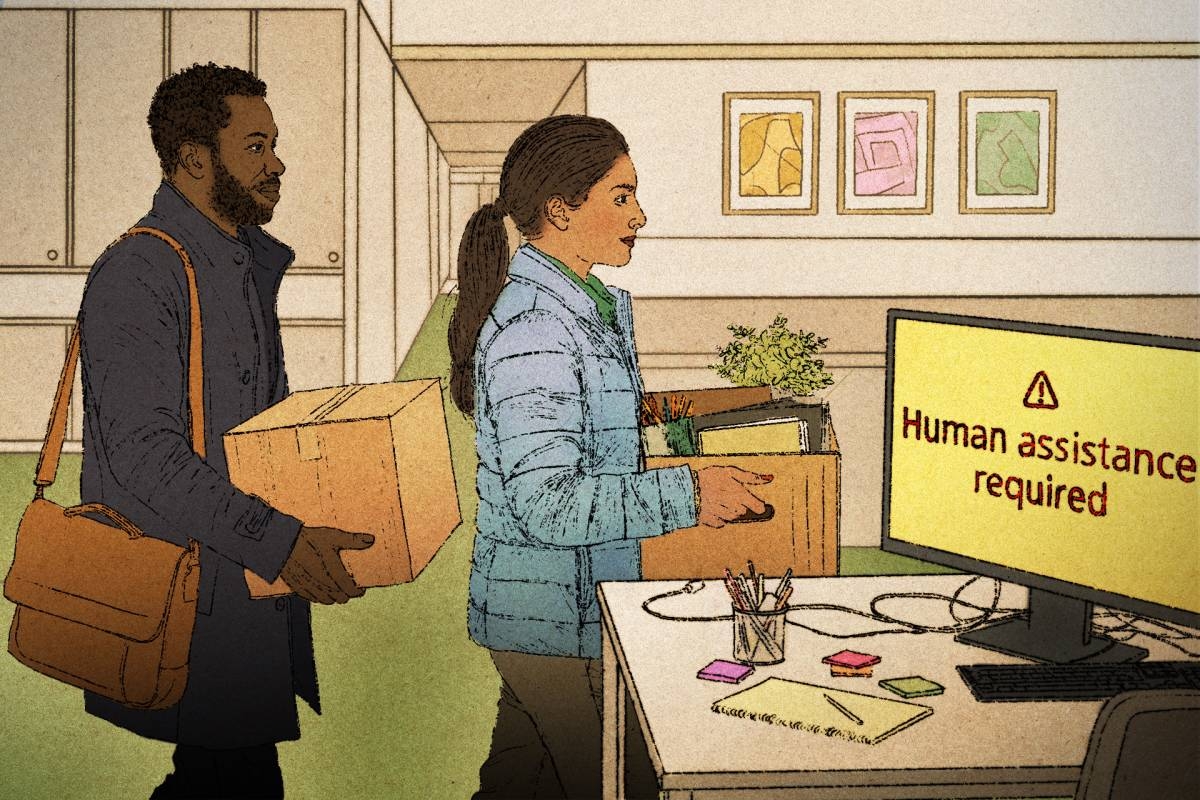
But the job cuts of the AI era, which are affecting tens of thousands of people, occasionally have an epilogue. Some companies, after discovering that AI models, applications and agents don't perform as well as expected, end up rehiring laid-off workers to fill eliminated positions.
It's unclear how common such reversals are, but they are happening often enough to acquire a nickname: the "AI boomerang."
"Two years ago, we said, 'Would this happen?' and now we're saying, 'Yes, it is happening in real time,'" said Lucy Beaumont, a global senior vice president at SHL, a U.K.-based technology company that develops employment-related tests and tools.
Hiring managers in fields including finance, marketing, law and health reported earlier this year that their companies had eliminated positions primarily because of AI or automation, only to hire again for the same or similar roles, according to recruitment and staffing firm Robert Half.
The most frequently cited reasons for restoring dropped jobs included the technology needing more human oversight than anticipated and its inability to replicate institutional knowledge, the firm said.
"When you need critical thinking, collaboration, creativity, institutional knowledge, those are things that AI just can't replicate," Bill Driscoll, a senior district president at Robert Half, said. "And I think that's where companies are starting to realize, 'Wow, we really do need people to do these jobs.'"
Klarna, the Swedish provider of buy now, pay later services, began recruiting human customer service representatives again last year. CEO Sebastian Siemiatkowski acknowledged in an interview with Bloomberg News that the company's reliance on an AI chatbot to cut costs had gone too far.
In June, Ford said it had hired or promoted 350 veteran engineers after AI tools the automaker deployed to do quality control work did not perform at the expected level.
"AI utilization has been an important part of our quality gains and that — along with deep technical expertise of our teams — is a powerful combination," a Ford spokesperson told The Associated Press.
However, companies don't always broadcast their U-turns on shifting resources or responsibilities from employees to AI systems, Beaumont said.
"Maybe their shareholders love that they did this right-sizing motion... and then they have to turn around and quietly, with their tail between their legs, admit that they weren't ready for that or they shouldn't have done that," she said.
Management experts offered employment advice for workers as companies make greater use of AI tools and consider — or reconsider — their staffing needs while assessing the technology's capabilities.
Rehiring suggests the invisible work of humans is not easily replaced
When companies use AI to perform tasks previously done by people, they often miss the invisible work employees do beyond their formal job descriptions, said Betsy Summers, a principal analyst on the Future of Work team at market research and advisory firm Forrester.
That might include sensing emotions and moods, holding impromptu meetings and putting in extra effort when feeling inspired or otherwise motivated, Summers said.
"We don't know all the work that's required to do things well within the organization," she said. "The citizenship behaviors of team cohesion and team building and making sure that you have trust within your team, none of that is accounted for. So when you rip out humans who are doing that work and then expect agents to be able to then deliver exactly what humans have delivered, they are frequently mistaken."
Another factor that complicates assigning more work to AI-powered tools is that company procedures for tasks such as data processing and bookkeeping are not always well documented, experts said.
"Organizations are not spending enough time doing the up-front work to really truly understand workflows and where humans add value in the process," said Brooks Holtom, a professor of management at Georgetown University's McDonough School of Business.
In roles such as customer service, AI agents and chatbots frequently need to refer questions and complaints to a worker who can recognize emotions, assess the severity or complexity of a problem and respond creatively within established policies, Holtom said.
"It's that combination of creativity but staying in the guardrail that's really hard for a machine to figure out," he said.
Figure out what gives you a competitive edge as a human
As companies redirect resources toward AI, current employees and those asked to come back might want to emphasize skills that complement the technology, such as emotional intelligence and sound judgment, Holtom said.
"Really try to be able to articulate, what's your value proposition as a human?" Holtom said. "Don't be afraid to lean into the technology as well, and understand how to differentiate yourself from what machines do well. Embrace that, understand that, and you can become uniquely qualified to help with implementation."
Empathy is a human quality that technology has not fully mastered, Beaumont said.
"Think about an angry customer. They want to be listened to, they want to be heard, they really want a human on the other end of the line," Beaumont said. "Can an AI replace that right now in a way that feels meaningful to individuals? Perhaps not."
Know your leverage and use caution if you're asked back
Many people are understandably reluctant to return to a company that laid them off as part of a reorganization around artificial intelligence, according to Beaumont.
"To come back to a business where you've been let go, replaced by AI, to be asked back to that business, your trust is gone, your psychological safety there, your relationship with the employer, and that's very, very difficult to build back," she said.
Workers offered their old jobs back are asking for more money and to know how AI might impact future staffing, Beaumont said. Requesting additional training and a clear explanation of your opportunities for advancement could be part of the discussion, she said.
Communicate ways you would contribute value as a returning employee, outlining a new job description "that leverages the technology but also your expertise," Holtom said. You could end up in a higher-ranking position that pays more than the one you left, he said.
Before accepting an offer, seek a commitment such as a one-year renewable contract that includes a buyout clause if the job is terminated in less than a year, Holtom suggested.
Don't discount the distinctly human values of motivation and curiosity, which make people efficient and effective, Summers said.
"Within our societies, work serves a broader purpose than just creating value for shareholders or customers or constituents," she added. "Work serves a human purpose as well. It's the manifestation of our search for meaning and purpose. We want to contribute to our communities as human beings."