The Latest: Moscow to keep some restrictions for 2 months
Jun 10, 2020
The Moscow mayor says it will take the Russian capital about two months to lift all coronavirus restrictions
MOSCOW — The Moscow mayor says it will take the Russian capital about two months to lift all coronavirus restrictions.
Sergei Sobyanin said at a government meeting that the situation in Moscow is improving, but the outbreak hasn’t been completely eradicated.
He said restrictions on mass gatherings remain, including theaters, cinemas, concert halls and sporting events. A decision whether to lift them will be made the beginning of July.
Starting Tuesday, Moscow residents are no longer required to stay at home or obtain electronic passes for traveling around the city. All restrictions on taking walks, using public transportation or driving have been lifted as well.
The lifted lockdown measures also allowed beauty parlors to reopen. Outdoor terraces of cafes and restaurants, as well as museums and dental clinics, are set to open on June 16. Kindergartens, gyms and indoor spaces of cafes and restaurants will be allowed to operate starting June 23.
In recent weeks, the officially reported daily number of new coronavirus infections in Moscow has dropped from over 6,000 to under 2,000. On Wednesday, health officials in the city reported a record low number of 1,195 new infections. In total, Moscow has so far registered 199,785 confirmed coronavirus cases, 40% of Russia’s caseload of over 493,000.
___
HERE’S WHAT YOU NEED TO KNOW TODAY ABOUT THE VIRUS OUTBREAK:
— Virus pummels global economy, jobs - even without 2nd wave
— In Pakistan, COVID-19 is just the latest epidemic in areas struck by chronic poverty, malnutrition and violence
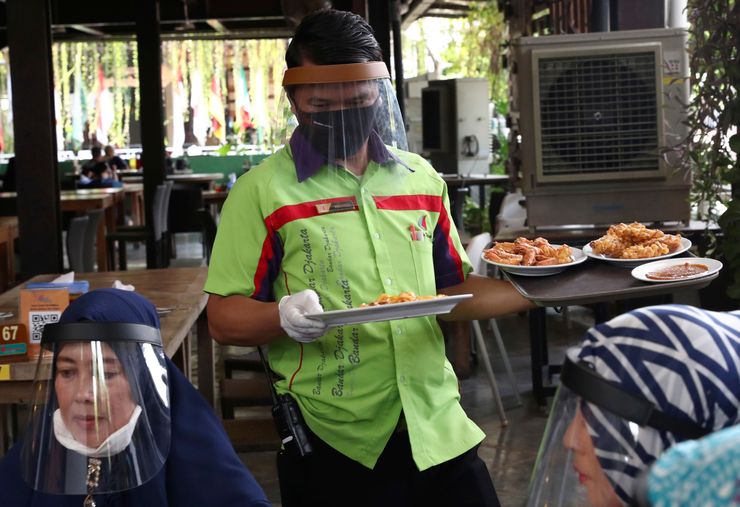
— Easing restrictions in Indonesia’s capital triggers concerns
— It’s an issue that’s been argued about for months, both by experts and by people strolling through parks all over the world: Can people who don’t feel sick spread the coronavirus, and if so should we all be wearing masks to stop it? Even the World Health Organization can’t seem to get it straight. On Tuesday the U.N. health agency scrambled to explain seemingly contradictory comments it has made in recent days about the two related issues.
— Moscow emerged from a strict lockdown with the city government citing a slowdown in the coronavirus outbreak and critics expressing concerns over the potential for a new wave of infections in the Russian capital. It comes weeks before a nationwide vote on the constitutional reform that would allow President Vladimir Putin to stay in power until 2036 and was condemned by Kremlin opponents as politically motivated.
— Experts worry that a further surge of the coronavirus in under-developed regions with shaky health systems could undermine efforts to halt the pandemic. Brazil, Mexico, South Africa, India and Pakistan are among the countries easing lockdown restrictions before their outbreaks have peaked and without detailed surveillance and testing systems in place.
___
Follow AP pandemic coverage at http://apnews.com/VirusOutbreak and https://apnews.com/UnderstandingtheOutbreak
___
HERE’S WHAT ELSE IS HAPPENING TODAY:
LONDON — Britain is planning to reopen zoos, safari parks and drive-in theaters as part of the easing of lockdown measures from the COVID-19 pandemic.
But the move by Prime Minister Boris Johnson is facing criticism amid the failure to reopen schools for all primary school students before summer, as had been planned.
Although many English primary schools have been open for children of key workers, the Conservative government had wanted to give all pupils the chance to return following months of home learning. But schools didn’t have enough space to address social distancing requirements.
Johnson is expected to make the announcement later Wednesday.
His Downing Street Office says it hopes that reopening of safari parks and zoos will help families spend time outdoors, where the chance of catching the virus is much lower.
London Zoo and other attractions across the country had warned they faced permanent closure if something weren’t done soon.
___
BERLIN — Germany is prolonging its travel warning for more than 160 countries outside Europe until the end of August.
The government agreed Wednesday to extend the guidance introduced on March 17 due to the coronavirus pandemic to almost all non-EU countries, with the exception of some that have successfully contained the outbreak.
Last week, Germany downgraded its travel warning for the rest of the 27-nation EU, Switzerland, Liechtenstein, Norway, Iceland and Britain.
Also Wednesday, the government announced the end of border controls for EU citizens coming to Germany. Almost all German states require travelers arriving from countries that have 50 new cases per 100,000 inhabitants in the past seven days to quarantine for two weeks. This is currently the case for fellow EU member state Sweden.
___
JOHANNESBURG — Africa’s confirmed coronavirus cases have surpassed 200,000.
That’s according to the Africa Centers for Disease Control and Prevention. The 54-nation continent has 202,782 cases and 5,516 deaths.
While Africa still represents a tiny percentage of the world’s total COVID-19 cases, well under 5%, officials in South Africa and elsewhere have expressed concern because the number of infections continues to climb.
South Africa leads the continent with 52,991 cases, with almost two-thirds of them in the Western Cape province centered on the city of Cape Town.
Egypt has 36,829 cases and Nigeria has 13,464.
___
ISLAMABAD — Pakistan’s coronavirus infections soared past 5,000 as the World Health Organization urged the government to impose a two-week lockdown to stem the relentless spike in new cases.
Pakistan has recorded 113,702 confirmed cases and 2,255 deaths.
Until now, Pakistan’s daily testing rate has hovered around 25,000, but the WHO says it should be double that.
Prime Minister Imran Khan has come under criticism from political opponents and health professionals for easing lockdowns despite soaring numbers and no progress in tracking COVID-19 outbreaks.
Khan, who has reprimanded Pakistanis for not wearing masks and keeping social distance, says the economy cannot survive a total lockdown and the poorest in Pakistan would be the hardest hit.
Pakistan was slow to rein in radical religious leaders who were initially allowed to invite Islamic missionaries to attend a massive gathering in mid-March, which was blamed for spreading infection as far as the Gaza Strip.
Khan also refused to shut down mosques during Ramadan and eased restrictions ahead of the Eid-al Fitr holiday. Since then the number of cases has continued to rise and medical workers worry the weak health system that has barely 3,000 ICU beds for a population of 220 million will be overwhelmed.
___
KUALA LUMPUR, Malaysia — Malaysia reopened nearly all economic and social activities Wednesday after a nearly three-month lockdown successfully brought down viral infections.
Malaysians can now travel for domestic holidays, get haircuts and shop at street markets. Schools and religious activities also will gradually resume.
While happy to be back at work, hairstylist Shirley Chai she is nervous about the strict health rules for hairdressers, especially the one-hour limit for each client.
“I couldn’t sleep at all last night. Very excited because everything is changing,” she said at her salon in a Kuala Lumpur shopping mall.
Malaysia has entered a “recovery” phase until the end of August with certain prohibitions still in place, but officials warn restrictions will be reinstated if infections soar again.
Night clubs, pubs, karaoke bars, theme parks and reflexology centers will stay shut. Contact sports or those with many spectators, and activities involving mass groups, are still banned.
Malaysia has had 8,336 confirmed infections and 117 deaths. Daily cases have dropped to only seven since Monday, the lowest since the lockdown started March 18.
___
NEW DELHI: India reported a new rise of nearly 10,000 coronavirus infections Wednesday, with a total caseload of 276,583, the fifth highest in the world.
The Health Ministry confirmed 9,985 new cases and 274 deaths in the last 24 hours. Total fatalities have reached 7,745.
Maharashtra, Tamil Nadu and New Delhi are the worst-hit states.
The spike comes as the government reopened restaurants, shopping malls and places of worship in most of India after a more than 2-month-old lockdown. Subways, hotels and schools remain closed.
India has so far tested more than 4.9 million people with a daily capacity crossing 140,000.
The number of new cases has soared since the government began relaxing restrictions. There has also been a surge in infections in rural India following the return of hundreds of thousands of migrant workers who lost their jobs during the lockdown.
___
SEOUL, South Korea -- South Korea has reported 50 new cases of COVID-19 as officials begin requiring nightclubs, karaoke rooms and gyms to register their customers with smartphone QR codes so they could be easily located when needed.
The figures from the Korea Centers for Disease Control and Prevention on Wednesday brought national totals to 11,902 cases and 276 deaths. At least 41 of the cases were reported from the densely populated Seoul metropolitan area, where officials have struggled to trace transmissions linked to entertainment venues, church gatherings and low-income workers who couldn’t afford to stay home.
Since late May, the country has been reporting around 30 to 50 new cases per day, a resurgence that has threatened to erase some of the hard-won gains against the virus as people begin to ease on distancing.
The nationwide requirement of QR codes at “high-risk” venues come after a trial run in the cities of Seoul, Incheon and Daejeon, where some 300 businesses used an app developed by internet company Naver to collect the information of some 6,000 customers. The government is also encouraging churches, libraries, hospitals and movie theaters to voluntarily adopt the technology.
South Korea has aggressively mobilized technological tools to trace contacts and enforce quarantines.
___
BEIJING — With much of the country reopened under safety measures, China has announced three new confirmed cases of coronavirus, all brought from outside the country.
No new deaths were reported Wednesday and just 55 people remain in treatment for COVID-19, while another 157 were being monitored in isolation for showing signs of having the virus or having tested positive for it without showing symptoms.
China has reported a total of 4,634 deaths among 83,046 cases of COVID-19 since the virus was first detected in the central Chinese city of Wuhan late last year.
___
Follow AP pandemic coverage at http://apnews.com/VirusOutbreak and https://apnews.com/UnderstandingtheOutbreak