Coronavirus claims an unexpected victim: Florida vegetables
Apr 8, 2020

Thousands of acres of fruits and vegetables grown in Florida are being plowed over or left to rot because farmers can't sell to restaurants, theme parks or schools nationwide that have closed because of the coronavirus

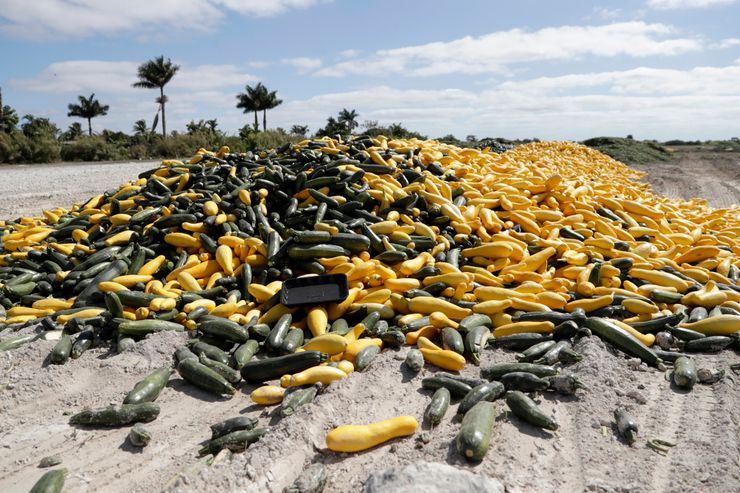
PALMETTO, Fla. (AP) — Mounds of harvested zucchini and yellow squash ripened and then rotted in the hot Florida sun. Juicy tomatoes were left to wither — unpicked — in farmers' fields.

Thousands of acres of fruits and vegetables grown in Florida are being plowed over or left to rot because farmers can’t sell to restaurants, theme parks or schools nationwide that have closed because of the coronavirus.

Other states are having the same issues — agriculture officials say leafy greens in California are being hit especially hard, and dairy farmers in Vermont and Wisconsin say they have had to dump a surplus of milk intended for restaurants.

With most of its harvests in the winter months, the problem is acute in Florida. For example, a few dozen people clamored to buy 25-pound (11- kilogram) boxes of Roma tomatoes direct from a packing plant over the weekend in Palmetto, a city on the western coast.

The cost per box? Just $5.

“This is a catastrophe,” said tomato grower Tony DiMare, who owns farms in south Florida and the Tampa Bay area. “We haven’t even started to calculate it. It’s going to be in the millions of dollars. Losses mount every day.”

Florida leads the U.S. in harvesting tomatoes, green beans, cabbage and peppers this time of year. While some of the crops are meant for grocery stores, many farmers cater solely to the so-called food service market — restaurants, schools and theme parks — hit hard as cities and states have ordered people to stay home and avoid others.

The loss has created a domino effect through the farming industry, Florida’s second-largest economic driver. It yields $155 billion in revenue and supports about 2 million jobs.

Many growers have donated produce to food banks, but there’s a limit on what the charities can accept and storage is an issue for perishable fruits and vegetables. DiMare said some central Florida food banks are full after theme parks shuttered and donated massive amounts of produce.

“We gave 400,000 pounds of tomatoes to our local food banks,” DiMare said. “A million more pounds will have to be donated if we can get the food banks to take it.”

Farmers are scrambling to sell to grocery stores, but it's not easy. Large chains already have contracts with farmers who grow for retail — many from outside the U.S.

“We can’t even give our product away, and we're allowing imports to come in here,” DiMare said.

He said 80 percent of the tomatoes grown in Florida are meant for now-shuttered restaurants and theme parks.

In the past week, 20 federal lawmakers from Florida and state Agriculture Commissioner Nikki Fried sent letters urging U.S. Agriculture Secretary Sonny Perdue to include Florida farmers in federal food purchase and distribution programs so the surplus crops can help feed the hungry and food insecure. Some 37 million Americans struggled with hunger before the pandemic, according to Feeding America, a nationwide network food banks.

The federal coronavirus relief act contains $9.5 billion in aid to farmers.

Some farmers have tried to branch out and sell produce boxes directly to customers, an approach taken in many places as the pandemic slams the restaurant and catering industries worldwide.

Wholesalers in London who usually sell fruit and vegetables to restaurants have pivoted to home deliveries. But large-scale farmers know selling harvest baskets won’t do much for their bottom line.

On the U.S. West Coast, farmers who grow lettuce and other leafy greens are feeling the pinch.

“The tail end of the winter vegetable season in Yuma, Arizona, was devastating for farmers who rely on food service buyers,” said Cory Lunde, spokesman for Western Growers, a group representing family farmers in California, Arizona, Colorado and New Mexico. “And now, as the production shifts back to Salinas, California, there are many farmers who have crops in the ground that will be left unharvested," particularly leafy greens.

He said a spike in demand for produce at the beginning of the outbreak has now subsided.

“People are staying home and not visiting the grocery stores as often," Lunde said. “So the dominoes are continuing to fall.”

In southern Florida, Paul Allen, president of R.C. Hatton Farms, took a video last week of row after row of vibrant green beans that were scheduled to be shipped to the restaurant industry.

“You can see this is a huge field of green beans,” he said, lifting his cellphone camera to show a tractor plowing all the healthy plants and their beans into the soil.

Allen, who farms about 12,000 acres (4,900 hectares) in Florida and Georgia, is praying that things improve by the time crops in north Florida and Georgia are ready to be harvested over the next two months.

“You just hope you can live another day,” Allen said.

___

Associated Press writer Amy Taxin contributed to this report from Orange County, California.

___

Follow AP coverage of the virus outbreak at https://apnews.com/VirusOutbreak and https://apnews.com/UnderstandingtheOutbreak.


More News

Body and soul, between heaven and earth

Oct 27, 2026

Body and soul, between heaven and earth

All Souls’ Day could possibly be more than its traditional concept. We hope that we touch the people we cherish through prayer — somewhere far away. And we visit them where they have left their bodies. We bring flowers to where their bodies rest. And in silence and gratitude, we pause while reminiscing about our shared memories. Two in one But what if the body is in the soul and yet the soul is inside the body? You see, those who have had near-death experiences, those very souls who have stood between the heavenly and earthly realms, tell us it is so. Those who were in life-and-death situations leave their bodies and yet feel they are more embodied than ever. They are overcome with a lightness of being, moving at a speed that is faster than light. They have a glimpse of pure freedom and joy. They see the hospital room and their bodies from above and feel no pain. They are given an instant sense of clarity that their body was living inside a much larger field. And at the same time, they feel their soul was always inside their body — tucked into every breath. A relative who survived a near-fatal heart attack told me, “I was not inside my body. My body was inside me.” A contradiction, perhaps. But it was his truth. Our soul is inside the body. That is why a cut can make you feel bad and why sickness can cause one to feel helpless. This is also the reason why a hand held in yours is not only comforting to the touch but also stirs something much deeper inside of you. It is love, something unseen that touches the spirit. And your body is inside your soul. This is why, when you love someone, you feel larger than life. And why, when you grieve, you do not seem to fit inside your body of skin. It is clear that body and soul are interconnected. Beyond walking There are two kinds of walking. Walking with the body — muscle, heart, bone. You count your strides and sweat all the way up to 3,000 steps. The body needs to be trained to endure in order to get stronger. And there is walking with the soul — when you walk long enough that your mind becomes still, unmuddled by everyday stress. Your feet find a familiar rhythm. Your breath deepens. This is when your soul catches up and walks with you. You see, the first walk burns calories, while the second walk burns the illusion that you are alone. People who return from the threshold are made to go back. Their mission isn’t over. They never talk about it as a dimension that is far away. They know it as some place close by. It is the very breath inside you — and you inside the breath. On All Souls’ Day, try to walk both walks. Walk with your body to the cemetery. And keep walking with your soul. Walk until you feel that you have never left your dearly departed loved ones. Nor have they left you. You are still inside their love. And they are still inside you. Between here and the hereafter, there is not a wall. There is a path. And we are all walking it — body and soul. Affirmation: “Heaven is within me.” Luke 17:21, KJV: “The kingdom of God is within you.” Love and light.

UK hydration brand enters Asia through Philippine market

Oct 27, 2026

UK hydration brand enters Asia through Philippine market

UK hydration brand Vidrate has entered the Asian market through the Philippines, marking its first expansion into the region in partnership with CTC Group Philippines. The launch was celebrated at “Get Vidrated,” an event held at the Pool House of Grand Hyatt Manila that featured yoga, sound healing, recovery stations and product demonstrations. Sarah Hulton, British Ambassador to the Philippines and Palau, attended the event and highlighted the United Kingdom’s strengths in health, science and consumer-product innovation. She noted that British businesses and entrepreneurs are developing products that help people lead healthier, more active lives. Hulton described Vidrate’s Philippine launch as an example of British innovation meeting Philippine entrepreneurship and market expertise. She also underscored the growing commercial relationship between the two countries and encouraged local retailers, distributors, wellness advocates and fitness businesses to explore opportunities with the brand. Founded by Nick Hird and Rob Bennett, Vidrate produces powdered hydration products in sachets that combine flavor, electrolytes, fiber and added vitamins. Its Everyday Hydration range contains zero sugar, natural ingredients and added vitamins C and B12. The company was ranked 28th nationally in “The Sunday Times 100” 2026, which recognizes the United Kingdom’s fastest-growing private companies. Its entry into the Philippines marks a step in its international expansion, with co-founder Hird looking to introduce the brand’s everyday hydration products to consumers in new markets. For CTC Group Philippines, the launch reflects its work in helping international brands establish a presence in the local market. The international business group operates in 12 countries, with a strong focus on life sciences, and supports companies through market expertise, regulatory awareness, strategic partnerships and local execution. CTC Group said it prioritizes responsible commercialization by assessing scientific evidence, substantiating product claims and complying with Philippine Food and Drug Administration requirements and other applicable regulatory standards. The company also considers whether products address relevant consumer and community needs, beyond their commercial potential. As the group continues to work with international companies across its network, its stated focus remains on connecting global innovation with local markets through scientific credibility, regulatory responsibility and strategic brand development.